Japan Power Plugs & Outlets: Do You Need an Adapter?
 komatsuna_admin
Planning a trip to Japan? Before you pack your phone charger, laptop, hair dryer, or other electronics, it is important to understand Japan's power plugs, electrical outlets, and voltage.
Japan mainly uses Type A power outlets, with two flat, parallel slots. The country's standard electricity supply is 100 volts (100V AC), which differs from the voltage used in many other countries.
The good news is that many modern phones, laptops, and camera chargers can be used in Japan with little difficulty. However, whether you need a plug adapter or voltage converter depends on the device you bring.
This guide explains how Japanese outlets work, how to check your charger's voltage rating, and what to prepare before your trip.
Quick Answer: Do You Need a Power Adapter in Japan?
You need a plug adapter if your device's plug does not fit a Japanese Type A outlet. You may also need a voltage converter if your device is not designed to operate on Japan's 100V electricity supply.
- Japan's main plug type: Type A (two flat, parallel pins).
- Standard voltage: 100V AC.
- Frequency: 50Hz in eastern Japan and 60Hz in western Japan.
- Phone and laptop chargers: Often compatible if labeled INPUT: 100–240V, 50/60Hz.
- Hair dryers and other high-power appliances: Require particular attention to voltage, frequency, and power ratings.
Important: A plug adapter changes the shape of the plug. It does not change the electrical voltage.
1. What Type of Power Plug Does Japan Use?
Japan primarily uses Type A plugs and outlets. A Type A plug has two flat, parallel metal pins and does not include a grounding pin.
This plug shape is familiar to travelers from the United States, Canada, and some other countries. However, a matching plug shape does not automatically mean that the device's electrical requirements are compatible with Japan's power supply.
Some Japanese buildings also have grounded outlets that accept Type B plugs, but travelers should not assume that a grounded Type B outlet will be available everywhere.
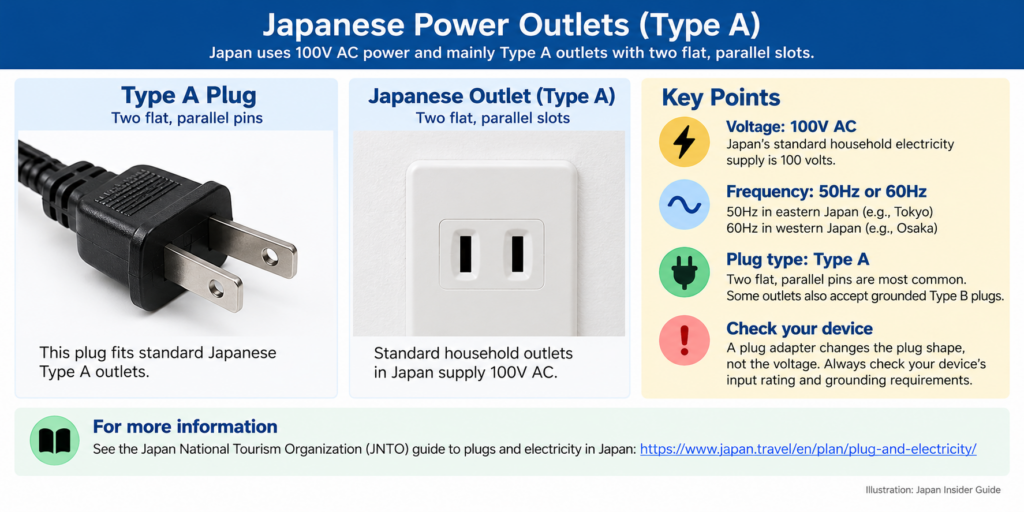
Japanese Type A plug and outlet. Japan mainly uses two flat, parallel pins and a 100V AC electricity supply. Illustration: Japan Insider Guide.
For an official explanation of Japan's electricity supply, see the Japan National Tourism Organization (JNTO): Plugs & Electricity.
If you want to compare plug shapes used in other countries, you can also consult the World Standards guide to international plug and socket types. This is an independent reference website, not a Japanese government source.
2. What Voltage Does Japan Use?
Japan's standard household electricity supply is 100V AC. This is lower than the approximately 120V commonly used in the United States and Canada and considerably lower than the 220–240V used in many European and Asian countries.
Voltage matters because electrical devices are designed to operate within specified input ranges. Using a device outside its rated voltage can cause poor performance, overheating, damage, or other safety problems.
Many modern electronic chargers support a wide voltage range, often 100–240V. These chargers can generally operate on Japan's 100V supply without a voltage converter, provided their frequency rating and other requirements are also compatible.
However, you should never assume that an appliance is compatible based only on its country of purchase or the appearance of its plug.
3. How to Check Your Charger's INPUT Rating
Before traveling, look for the electrical rating printed on your charger, power adapter, or appliance. The information is usually marked near the word INPUT.
For example, a charger may display:
INPUT: 100–240V~ 50/60Hz
This means the charger is designed to accept AC power between 100 and 240 volts at either 50Hz or 60Hz. Such a charger is generally suitable for Japan's electricity supply, although you may still need a plug adapter.
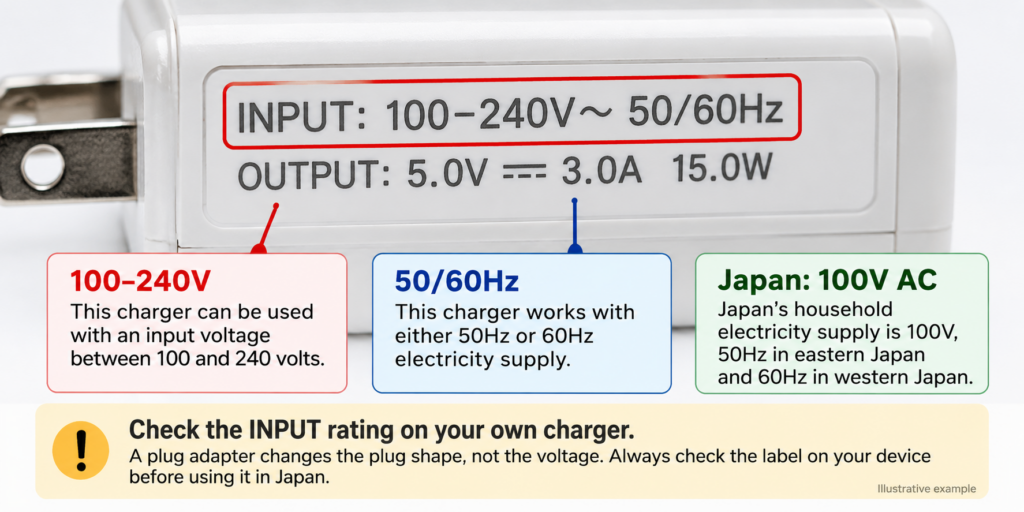
Example of a universal-voltage charger label. Check the INPUT rating on your own charger before using it in Japan. A plug adapter changes the plug shape, not the voltage. Illustration: Japan Insider Guide.
Note: The image above is an educational illustration, not a photograph of a specific commercial charger. Always check the rating on your actual device.
What If the Label Says 220–240V Only?
A device rated only for 220–240V is not designed to operate directly from Japan's 100V supply. Depending on the appliance, it may require an appropriately rated step-up transformer, or it may be better to use a locally compatible alternative.
High-power appliances such as hair dryers, kettles, and heating devices can be especially difficult to use with travel voltage converters. Check the appliance manufacturer's instructions and the converter's power capacity before attempting to use one.
What If the Label Says 110–120V Only?
Some appliances designed for North American electricity may operate differently on Japan's lower 100V supply. Compatibility depends on the appliance, and performance should not be assumed. Follow the manufacturer's guidance rather than relying on the plug fitting the outlet.
4. Japan's Electricity Frequency: 50Hz vs. 60Hz
Japan has an unusual electricity system because different regions use different AC frequencies:
- Eastern Japan: Generally 50Hz, including Tokyo and Yokohama.
- Western Japan: Generally 60Hz, including Osaka, Kyoto, and Nagoya.
Most modern phone chargers, laptop power supplies, and similar electronics are designed for both frequencies. Look for 50/60Hz on the device's input label.
Some appliances that use motors, timers, or frequency-dependent components may be affected by the difference. If your device specifies only one frequency, consult its manufacturer before using it in another region.
JNTO confirms Japan's regional frequency difference in its official electricity guide.
5. Do You Need an Adapter Based on Your Home Country?
Your need for a plug adapter depends primarily on the shape of the plug attached to your device. The table below provides a general starting point for travelers from common departure regions.
| Country or Region | Common Plug Types | Adapter for Japan? |
|---|---|---|
| United States | A, B | Usually not for Type A plugs; grounded Type B plugs require a suitable grounded outlet. |
| Canada | A, B | Usually not for Type A plugs; check grounded plugs and voltage. |
| United Kingdom | G | Yes, usually a Type G-to-Type A adapter. |
| Most of continental Europe | C, E, F and others | Yes, usually an appropriate adapter for Japan. |
| Australia and New Zealand | I | Yes, usually a Type I-to-Type A adapter. |
| Singapore | G | Yes, usually a Type G-to-Type A adapter. |
| South Korea | C, F | Yes, usually an appropriate adapter for Japan. |
| India | C, D, M | Yes, usually an appropriate adapter for Japan. |
Important: This table addresses plug shape, not guaranteed electrical compatibility. A plug adapter does not convert voltage or automatically provide protective grounding.
To check your own country's plug types before traveling, see the country-by-country plug, socket, and voltage reference from World Standards. Because electrical installations and appliance designs vary, confirm the requirements of your own equipment.
6. Plug Adapter vs. Voltage Converter: What's the Difference?
A plug adapter and a voltage converter serve different purposes. Understanding the difference is one of the most important steps in preparing electronics for Japan.
Plug Adapter
A plug adapter allows a plug with one pin configuration to fit an outlet with another configuration. For example, a traveler from the United Kingdom may use an adapter that allows a Type G plug to connect to a Japanese Type A outlet.
An ordinary plug adapter does not change 100V into 230V or 120V. It also does not necessarily preserve grounding, so you must choose an adapter suitable for your device's electrical and safety requirements.
Voltage Converter or Transformer
A voltage converter or transformer changes the voltage supplied to a device. The correct type depends on whether the appliance requires a higher or lower voltage, its power consumption, and the manufacturer's specifications.
For example, a device designed exclusively for 230V may require a suitable step-up transformer to operate from Japan's 100V supply. However, not every appliance is suitable for operation through a travel converter.
For high-wattage appliances, it may be safer and more practical to use equipment designed for Japan's electricity system.
7. Can You Charge Your Phone or Laptop in Japan?
In many cases, yes. Modern smartphones, tablets, cameras, and laptops commonly use chargers that support 100–240V AC, 50/60Hz.
If your charger's INPUT rating includes 100V and the appropriate frequency, you generally do not need a separate voltage converter for that charger. You only need to make sure its plug can connect safely to the available outlet.
Check the power adapter itself, rather than assuming the device's brand or model guarantees worldwide compatibility.
USB Charging in Hotels
Some hotels in Japan provide USB charging ports or other charging facilities, but availability varies by property and room. Bringing your own compatible charger and plug adapter is a sensible precaution.
Do not assume that every USB port supports the charging speed or power output required by your device. Laptops and other high-power electronics may require their own power adapters.
8. What About Hair Dryers, Curling Irons, and Other Appliances?
Hair dryers, curling irons, electric shavers, and similar appliances deserve extra attention because their electrical requirements can differ significantly.
A dual-voltage appliance may be suitable for Japan if its specified input range includes 100V and its frequency and operating instructions permit use there. Some dual-voltage products also require a manual voltage setting, so check the manufacturer's directions before connecting them.
An appliance designed only for 220–240V should not be plugged directly into a Japanese outlet using only a plug adapter.
For a high-power appliance, check its wattage as well as its voltage. A travel converter that cannot safely handle the required power may overheat or fail.
When possible, consider using the hair dryer provided by your accommodation or purchasing a suitable appliance locally instead of bringing a voltage-sensitive model from home.
9. Where Can You Buy a Plug Adapter in Japan?
Travel plug adapters and some voltage-conversion products are available from major electronics retailers in Japan. JNTO identifies large electronics stores and shopping districts such as Akihabara in Tokyo and Nipponbashi in Osaka as places where travelers may find electrical accessories.
Availability, plug configurations, and product ratings vary, so it is usually easier to purchase a suitable adapter before departure.
When buying an adapter, check the supported plug types, current and power ratings, and grounding requirements. Avoid products that do not clearly identify their electrical specifications.
10. Safety Tips for Using Electrical Devices in Japan
- Check the INPUT voltage and frequency on every charger or appliance before use.
- Use an adapter designed for the actual plug and outlet configuration.
- Do not force a plug into an outlet.
- Never remove or bypass a grounding pin to make a plug fit.
- Do not assume that a plug adapter converts voltage.
- Keep chargers and electrical connections away from water.
- Do not exceed the current or wattage rating of adapters, power strips, or converters.
- Stop using any electrical accessory that becomes unusually hot, damaged, or unstable.
- Consult the manufacturer's instructions if you are uncertain about compatibility.
Frequently Asked Questions About Power Plugs in Japan
Does Japan use the same plugs as the United States?
Japan mainly uses Type A outlets, which resemble the two-flat-pin plugs used in the United States. However, Japan's standard voltage is 100V rather than the approximately 120V used in the United States. Grounded Type B outlet availability also varies.
Do I need a travel adapter for Japan from the UK?
Usually, yes. Standard UK Type G plugs do not fit Japanese Type A outlets. You will generally need a suitable adapter, and you must separately check that your device supports Japan's 100V supply.
Do I need a voltage converter to charge my iPhone in Japan?
If the charger you use is rated for 100–240V AC, 50/60Hz, a separate voltage converter is generally unnecessary. Check the actual charger label and make sure its plug is compatible with the outlet.
Can I use a European charger in Japan?
Many European phone and laptop chargers support 100–240V and can operate on Japan's electricity supply. However, their plugs often require a suitable Type A adapter. Check both the plug shape and the charger's INPUT rating.
Can I use a 220V hair dryer in Japan?
A hair dryer rated only for 220V is not designed to operate directly on Japan's 100V supply. A simple plug adapter is not sufficient. Because hair dryers consume substantial power, check the manufacturer's instructions before considering a transformer or converter.
Are power outlets available on Japanese trains?
Some Shinkansen trains and other services provide electrical outlets, but availability depends on the train type, carriage, and seat. Do not rely on having an outlet at every seat; charge essential devices before traveling.
Final Checklist: What to Pack for Japan
- Check whether your plugs fit Japanese Type A outlets.
- Pack a suitable travel plug adapter if needed.
- Verify that each device supports 100V AC.
- Check for 50/60Hz compatibility.
- Confirm grounding requirements for three-pin devices.
- Review the wattage of high-power appliances.
- Bring the correct charging cables and power adapters.
- Check your accommodation's charging facilities if you depend on specific equipment.
Official Information and Further Reading
For reliable information before your trip, consult the following references:
- Japan National Tourism Organization (JNTO) — Plugs & Electricity: Official Japanese tourism information about plugs, voltage, and regional frequency differences.
- JNTO — Frequently Asked Questions: Additional official travel guidance, including Japan's electricity specifications.
- World Standards — Plug & Socket Types: Independent reference covering international plug configurations.
- World Standards — Plug, Socket & Voltage by Country: Independent country-by-country comparison for travelers.
Conclusion: Prepare the Right Adapter Before Traveling to Japan
Japan mainly uses Type A power outlets and a 100V electricity supply. For many travelers, preparing the right plug adapter and checking their charger's INPUT rating is all that is needed to charge everyday electronics safely.
The most important rule is simple: check both the plug shape and the electrical rating of your device. A plug that fits is not necessarily a device that is electrically compatible.
With a little preparation, you can keep your phone, camera, laptop, and other essential devices ready throughout your trip to Japan.