How to Use Japanese Toilets: A Complete Guide for First-Time Visitors
 komatsuna_admin
Japan is famous for its clean, comfortable, and surprisingly high-tech toilets. For many international visitors, using a Japanese toilet for the first time can be an unexpected cultural experience.
Some toilets have heated seats, built-in bidets, automatic lids, and control panels filled with unfamiliar Japanese characters. Others are simple, traditional squat toilets.
The good news? Japanese toilets are generally easy to use once you understand a few basic features.
This guide explains how Japanese toilets work, what the most common buttons mean, and the etiquette you should know before using public restrooms in Japan.
1. What Makes Japanese Toilets Different?
Japanese toilets range from basic models to sophisticated electronic systems.
Modern toilets, often called washlets or bidet toilets, may include:
- Heated toilet seats
- Rear and front washing functions
- Adjustable water pressure
- Adjustable nozzle position
- Warm-air drying
- Automatic flushing or lid opening
- Privacy sounds that help mask bathroom noises
Not every toilet has all these features. The available functions depend on the model and location.
You may find advanced toilets in hotels, department stores, shopping malls, airports, and even some public restrooms.
2. How to Use a Japanese Bidet Toilet
If you encounter a modern Japanese toilet, follow these basic steps.
Step 1: Check the toilet seat
Some toilets have automatic lids, while others require you to lift the lid manually. Make sure the seat is in the correct position before using the toilet.
Step 2: Sit down normally
Most modern Japanese toilets are Western-style seated toilets.
Bidet washing functions are generally designed to operate while you are seated. Some models have sensors that prevent them from activating when no one is sitting on the seat.
Step 3: Choose a washing function
After using the toilet, you can press the rear wash or front wash button if you wish to use the bidet.
The washing function is optional. You can use toilet paper instead.
Step 4: Adjust the settings if necessary
Some models allow you to change the water pressure or nozzle position. Start with a gentle setting if you are unfamiliar with the controls.
Step 5: Press Stop
Press the Stop button to end the washing function.
Step 6: Flush the toilet
Look for a flush button, wall-mounted control, lever, or sensor. The flushing mechanism may be separate from the bidet control panel.
Some toilets flush automatically, but you should always check before leaving.
3. Understanding Japanese Toilet Buttons
One of the most confusing parts of using a Japanese toilet is the control panel.
Buttons may display Japanese characters, English words, or simple symbols. Their appearance and arrangement vary by manufacturer and model.
The illustration below shows examples of common functions.
Common Toilet Button Functions
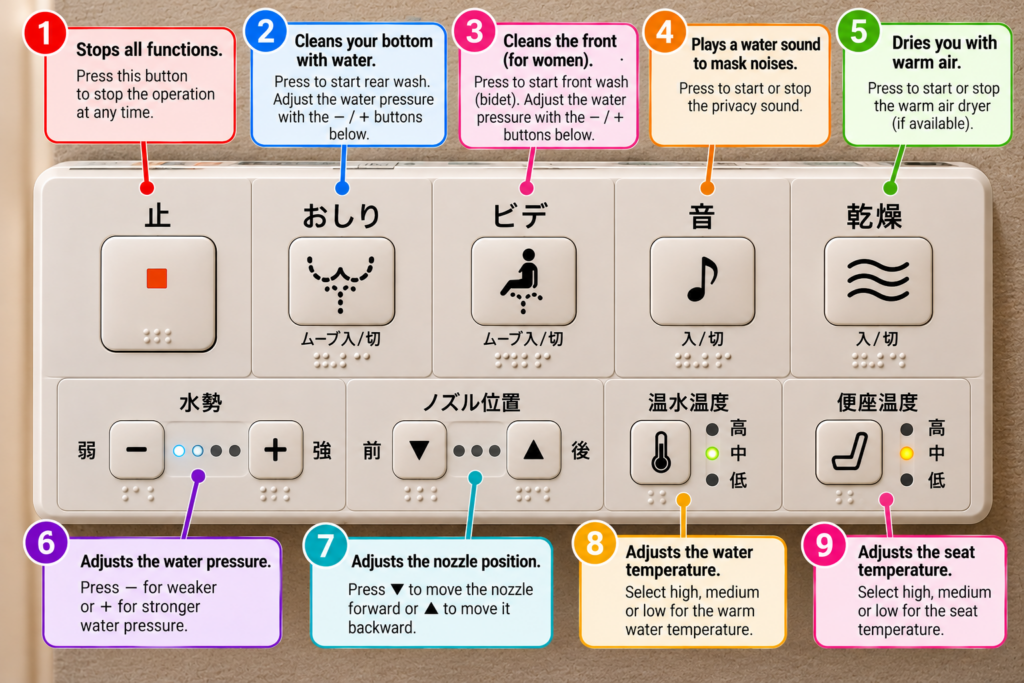
① Stop (止)
Stops the washing or drying function. On some models, the Japanese label is written as 止 or 停止.
② Rear Wash (おしり)
Activates a water spray designed to wash the rear area.
③ Front Wash (ビデ)
Activates a gentler washing function intended for the front area.
④ Privacy Sound (音姫 or similar labels)
Plays a sound, often running water, to help mask bathroom noises. This feature is available only on certain models.
⑤ Dryer (乾燥)
Provides warm air for drying after washing. Not all toilets include this function.
⑥ Water Pressure (水勢)
Adjusts the strength of the washing spray. Use the lower setting first if you are unsure.
⑦ Nozzle Position (ノズル位置)
Moves the washing nozzle forward or backward to adjust the spray position.
⑧ Water Temperature (温水温度)
Changes the temperature of the washing water on models that support this adjustment.
⑨ Seat Temperature (便座温度)
Adjusts the temperature of the heated toilet seat.
Important: This illustration is a general guide, not a representation of every Japanese toilet. Actual labels, functions, and button locations vary.
If you are unsure which button to press, avoid experimenting with unfamiliar controls unnecessarily.
4. How to Flush a Japanese Toilet
Flushing is not always controlled by the same panel as the bidet functions.
You may encounter:
- A lever on the side of the toilet tank
- A wall-mounted flush button
- A sensor near the toilet
- Buttons labeled 大 (large flush) and 小 (small flush)
- An automatic flushing system
The character 大 generally indicates a larger flush, while 小 indicates a smaller flush.
Be careful not to confuse a privacy sound button with the actual flush control. A sound resembling running water does not necessarily mean the toilet has flushed.
Before leaving, make sure the toilet has flushed properly.
5. Japanese Toilet Etiquette: Important Rules
Japan is known for clean public restrooms, and visitors can help maintain them by following a few simple rules.
Flush Used Toilet Paper
In most standard Japanese toilets, ordinary toilet paper should be flushed.
Never flush wet wipes, sanitary products, paper towels, or similar items. They can clog the toilet, cause wastewater to overflow or back up, and damage the plumbing system.
Follow any posted instructions, especially in facilities with special plumbing systems.
Keep the Toilet Area Clean
Avoid splashing water or leaving paper on the floor. If you accidentally make a mess, clean it up as reasonably as you can.
Respect Shared Facilities
Avoid occupying a restroom stall longer than necessary when others are waiting.
Keep noise to a reasonable level, and respect other people’s privacy.
Do Not Stand on a Western-Style Toilet Seat
Western-style toilets are designed for sitting, not squatting on the seat. Standing on the seat can cause injury or damage.
6. What About Traditional Japanese Squat Toilets?
Although Western-style toilets are now common, traditional Japanese squat toilets can still be found in some older buildings, parks, and public facilities.
A Japanese squat toilet is installed at floor level.
To use one, face the raised hood or front end of the fixture, position your feet on either side, and squat carefully.
Be sure to keep your balance, particularly if the floor is wet.
If you are uncomfortable using a squat toilet, look for another stall with a Western-style toilet when available.
7. Where Can You Find Public Toilets in Japan?
Public restrooms are widely available in many parts of Japan.
Common locations include:
- Train stations
- Airports
- Shopping malls and department stores
- Parks and tourist attractions
- Museums and major public facilities
- Convenience stores, where customer toilet access is permitted
Restroom availability varies by location. Some convenience stores do not offer customer toilets, and others may restrict access.
Signs may display the word “Toilet,” “Restroom,” or familiar restroom symbols.
Many major transportation hubs and shopping facilities also offer accessible restrooms and baby-changing facilities.
8. What If You Cannot Find a Toilet or Understand the Controls?
If you cannot find a restroom, ask a station employee, hotel receptionist, or information desk staff member.
A useful Japanese phrase is:
トイレはどこですか?
Toire wa doko desu ka?
English: Where is the toilet?
If you are unsure about a control panel, look for pictograms or English labels before pressing buttons.
Translation apps can also help you understand Japanese instructions.
If a bidet function seems confusing, remember that using it is optional. You can simply use the toilet normally and flush afterward.
Final Thoughts
Japanese toilets may look complicated at first, but they are designed to make everyday life more comfortable and hygienic.
You do not need to master every button to use one confidently.
Learn the basic washing and flushing controls, follow local restroom etiquette, and enjoy discovering one of the small but memorable details of traveling in Japan.
At Japan Insider Guide, we believe understanding everyday customs can make your journey smoother, more comfortable, and more rewarding.