How to Use Chopsticks in Japan: A Beginner’s Guide to Holding Them and Dining Etiquette
 komatsuna_admin
During a trip to Japan, you will encounter chopsticks in many places, from ramen shops and soba restaurants to traditional Japanese restaurants and izakaya pubs.
Chopsticks are one of the most recognizable parts of Japanese food culture. But if you have never used them before, picking up food with two slender sticks may feel surprisingly difficult.
Even if you already know how to use chopsticks, you may not be familiar with some of Japan's dining etiquette.
This guide explains how to hold and move chopsticks, how to practice using them, and which chopstick habits to avoid when dining in Japan.
You do not need to be perfect. Learning a few basics can help you enjoy Japanese meals with greater confidence.
1. When Do People Use Chopsticks in Japan?
In Japan, chopsticks are used for many kinds of food, including rice, fish, vegetables, and noodles.
Common examples include:
- Teishoku: set meals served with rice and side dishes
- Soba, udon, and ramen noodles
- Grilled fish and simmered dishes
- Sushi and sashimi
- Small dishes served at izakaya pubs
However, not every Japanese meal is eaten with chopsticks.
For example, Japanese curry rice and omurice (an omelet served over rice) are commonly eaten with a spoon. Forks and knives are also widely used for Western-style dishes.
Sushi can be eaten with either chopsticks or your hands.
The important thing is to use utensils that suit the food and the dining situation.
2. How to Hold Chopsticks Correctly
The basic technique is to keep the lower chopstick steady while moving the upper chopstick to pick up food. You do not need to move both chopsticks equally.
Step 1: Position the Lower Chopstick
Rest the lower chopstick near the base of your thumb and support it with your ring finger.
This chopstick acts as a stable base, so try to keep it relatively still.
Step 2: Hold the Upper Chopstick
Hold the upper chopstick in a way similar to holding a pencil, using your thumb, index finger, and middle finger.
Step 3: Move the Upper Chopstick
Use your index and middle fingers to move the upper chopstick up and down.
Keep the lower chopstick steady while opening and closing the tips to grip food.
If these instructions are difficult to visualize, watch the demonstration below.
Video Tutorial: How to Hold and Move Chopsticks
The following video by SAMUKICHI – Japan food studio demonstrates how to hold chopsticks, with close-up views of the fingers and chopstick movements.
Try holding a pair of chopsticks while watching the video, and practice moving your fingers slowly.
3. How to Practice Using Chopsticks
If you are a beginner, start with objects that are easy to pick up rather than tiny pieces of food.
For example, you can practice with small pieces of sponge or a large eraser. Once you feel more comfortable, try picking up small pieces of vegetables.
Focus on three things:
- Keep the lower chopstick as steady as possible.
- Open and close the upper chopstick slowly.
- Bring the tips together to grip the object.
Do not worry if you cannot do it perfectly at first.
People hold and use chopsticks in slightly different ways. Your first goal should be to pick up and carry food safely and comfortably.
4. Six Chopstick Etiquette Mistakes to Avoid in Japan
Japan has several traditional rules about how chopsticks should and should not be used at the table.
Improper chopstick habits are sometimes called kirai-bashi or imi-bashi. Some are connected to Japanese funeral and memorial customs, while others are considered poor table manners.
Here are six behaviors worth knowing before your trip.
1. Tate-bashi: Standing Chopsticks Upright in Rice
Do not stick your chopsticks vertically into a bowl of rice.
In Japan, this can resemble rice offerings made for the deceased and is associated with funeral or memorial practices. It should be avoided during an ordinary meal.
When you need to put your chopsticks down, use a chopstick rest or place them horizontally in an appropriate spot.
There is also a different etiquette mistake called sashi-bashi, which means spearing food with chopsticks. We explain that in item six.
2. Hashi-watashi: Passing Food from Chopsticks to Chopsticks
Do not pass food directly from your chopsticks to another person's chopsticks.
This resembles a Japanese funeral custom in which cremated bones are handled and passed between people using chopsticks.
For that reason, passing food directly between pairs of chopsticks is strongly discouraged at the dining table.
If you want to share food, place it on a separate plate instead.
3. Mayoi-bashi: Hesitating Over Food with Your Chopsticks
Do not hover your chopsticks over several dishes while deciding what to eat.
For example, moving your chopsticks back and forth over different dishes while trying to choose a piece of food is considered poor manners.
Try to decide what you want before reaching toward the food.
4. Neburi-bashi: Licking or Sucking Chopsticks
Avoid licking or sucking the tips of your chopsticks.
This includes licking off sauce or seasoning that remains on the chopsticks.
Such behavior may be seen as impolite in Japan. Avoid unnecessarily licking the tips or keeping your chopsticks in your mouth.
5. Yose-bashi: Pulling Dishes Toward You with Chopsticks
Do not use your chopsticks to drag a plate or bowl toward you.
For example, hooking your chopsticks around the edge of a small dish and sliding it closer is considered poor table manners.
If you need to move a dish, use your hands instead. Be careful with hot or heavy dishes.
6. Sashi-bashi: Spearing Food with Chopsticks
Do not stab food with the tips of your chopsticks and carry it to your mouth as though the chopsticks were a fork.
For example, you might find it difficult to pick up a soft potato or a piece of simmered vegetable and feel tempted to pierce it with a chopstick.
However, this is known as sashi-bashi and is generally discouraged in Japanese dining etiquette.
Chopsticks are primarily used to grip or support food between two sticks.
If a soft piece of food is difficult to pick up, try dividing it into smaller pieces or gently holding it between the chopsticks. Depending on the dish and situation, a spoon may also be helpful.
Remember that sashi-bashi is different from tate-bashi. Standing chopsticks upright in rice is associated with funeral and memorial customs, while spearing food is a separate issue of table manners.
Illustrated Guide: Six Chopstick Behaviors to Avoid
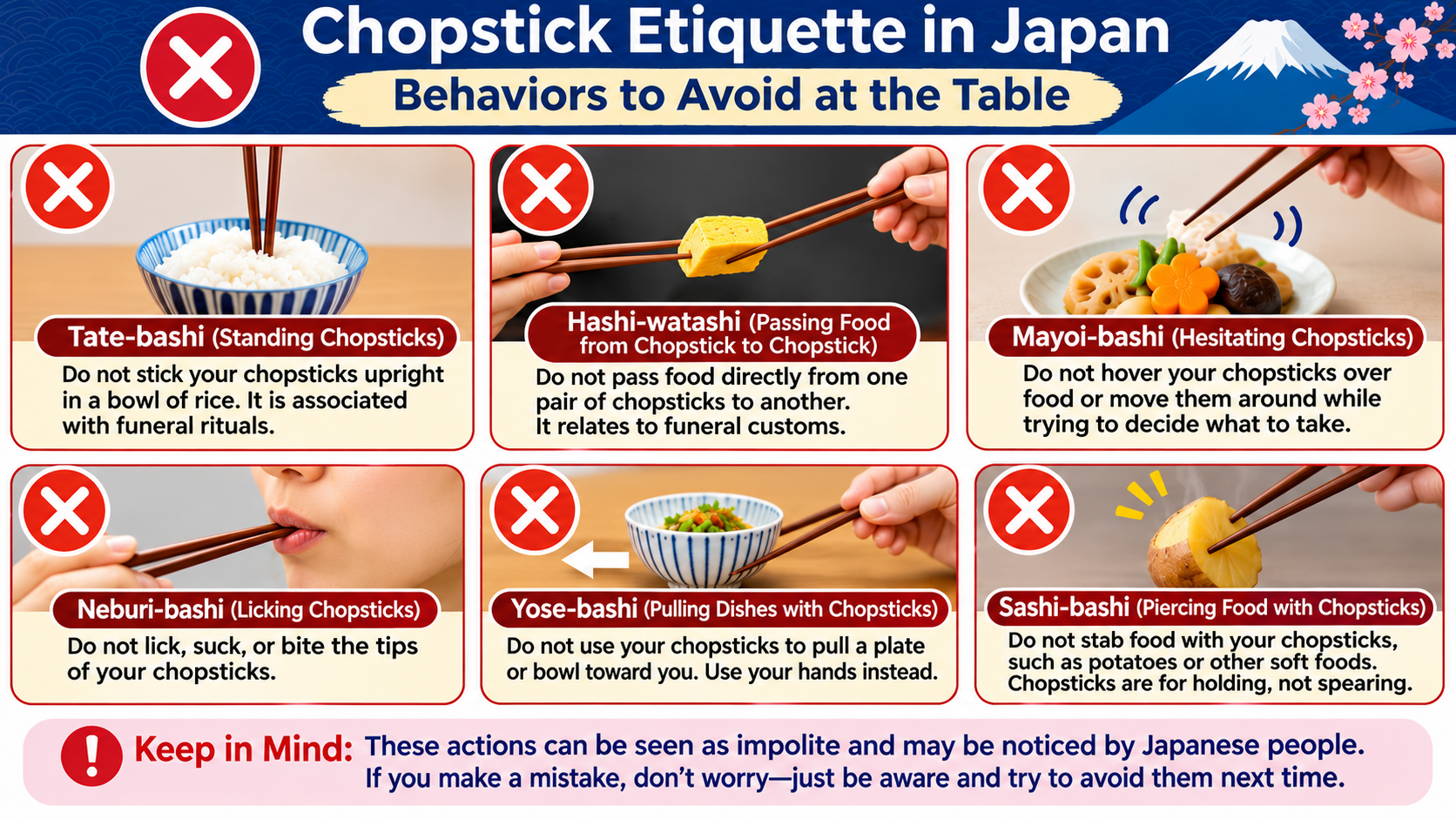
These behaviors may be considered impolite by Japanese dining companions, and someone may occasionally point them out.
However, there is no need to panic if you make a mistake without realizing it.
Simply correct yourself when you notice and try to be considerate of the people around you.
5. How to Use Disposable Chopsticks in Japan
Many Japanese restaurants provide disposable wooden or bamboo chopsticks called waribashi.
You may also be asked whether you need chopsticks when buying a boxed meal, or bento, at a Japanese convenience store.
For example, a cashier might ask:
「お箸はお付けしますか?」
Ohashi wa otsuke shimasu ka?
"Would you like chopsticks?"
If you need them, you can reply:
「はい、お願いします」
Hai, onegai shimasu.
"Yes, please."
If you do not need them, you can say:
「いいえ、大丈夫です」
Iie, daijōbu desu.
"No, thank you."
Some stores may not ask automatically. Depending on the store, you might need to request chopsticks or take them from a designated area.
For more convenience store shopping tips, see our guide to what to buy at Japanese convenience stores.
Disposable chopsticks often come as a connected pair that you separate before use.
Break them apart gently, taking care not to hit nearby people or dishes.
Rubbing disposable chopsticks together vigorously after separating them may be considered impolite in some dining situations.
If the chopsticks have rough splinters, avoid using them if they seem unsafe and ask for a replacement when possible.
Where Should You Put Your Chopsticks During a Meal?
If a chopstick rest is provided, use it when you are not eating.
If there is no chopstick rest, you can sometimes fold a clean paper chopstick sleeve into a simple rest.
Placing chopsticks across the top of a bowl or plate is called watashi-bashi and may be discouraged under traditional Japanese table manners.
When in doubt, use a chopstick rest or a clean paper sleeve.
6. What If You Cannot Use Chopsticks Well?
Some visitors to Japan have little or no experience using chopsticks.
That does not mean you cannot enjoy Japanese food.
Some restaurants have forks or spoons available, and you can ask a staff member if you need one.
To ask for a fork, say:
「フォークはありますか?」
Fōku wa arimasu ka?
"Do you have a fork?"
To ask for a spoon, say:
「スプーンはありますか?」
Supūn wa arimasu ka?
"Do you have a spoon?"
However, not every restaurant provides alternative utensils.
Restaurant staff or other diners may not always be able to teach you how to use chopsticks, either.
Practicing a little before your trip can make dining in Japan more enjoyable.
7. Are Japanese People Strict About Chopstick Etiquette?
Many people in Japan learn to use chopsticks during childhood, and some families place considerable importance on proper chopstick technique and table manners.
As a result, some people pay attention to how others hold and use their chopsticks.
However, chopstick techniques vary between individuals, and not every Japanese person holds chopsticks in exactly the same way.
Visitors are not necessarily criticized simply because they are inexperienced.
What matters is not only perfect technique but also showing consideration for the people sharing your meal.
It is especially useful to understand customs such as tate-bashi and hashi-watashi, which have particular cultural associations in Japan.
Learning about chopsticks can also help you better understand Japanese food culture.
8. Enjoy Japanese Dining with Confidence
Chopsticks are more than a tool for bringing food to your mouth.
They can be used to separate pieces of fish, pick up small side dishes, and lift noodles. These everyday movements are part of the experience of eating Japanese food.
Using chopsticks may feel challenging at first, but practice can make the movements more natural.
Understanding Japanese dining etiquette can also help you feel more comfortable in restaurants and izakaya pubs.
Learning to use chopsticks might even become one of the memorable experiences of your trip.
Final Thoughts
You do not need perfect chopstick skills before visiting Japan.
Start by practicing the basic technique: keep the lower chopstick steady and move the upper one to grip food.
It also helps to recognize common etiquette mistakes, including tate-bashi, hashi-watashi, mayoi-bashi, neburi-bashi, yose-bashi, and sashi-bashi.
If you struggle with chopsticks, you can ask whether a fork or spoon is available.
The most important thing is to respect local dining customs while enjoying Japanese food and culture.
On your next trip to Japan, why not give chopsticks a try?