Earthquakes in Japan: A Practical Safety Guide for Tourists
 komatsuna_admin
Japan is one of the most fascinating countries in the world to explore. From the busy streets of Tokyo and Osaka to historic temples in Kyoto and beautiful coastal towns, there is an extraordinary variety of places to visit.
However, if you are planning a trip to Japan, you may have one important concern: earthquakes.
How often do earthquakes happen in Japan? What should you do if an earthquake strikes while you are staying in a hotel, riding a train, or exploring a city? And how can you stay safe if a tsunami warning is issued?
Japan experiences frequent seismic activity, but the country has also developed extensive earthquake preparedness measures, including earthquake-resistant construction, early warning systems, and designated evacuation facilities.
The key to traveling safely is not to fear every earthquake, but to understand the risks and know how to respond.
This practical guide explains what international visitors should know about earthquakes in Japan, including emergency alerts, tsunami evacuation towers, elevation signs, useful apps, and essential Japanese phrases.
1. Why Does Japan Have So Many Earthquakes?
Japan is located in a geologically active region where several tectonic plates interact. Movement along these plate boundaries and faults can generate earthquakes of different sizes.
Many earthquakes are too small to cause significant damage, while others can produce strong shaking, landslides, fires, infrastructure disruptions, or tsunamis.
Magnitude vs. seismic intensity
When following earthquake news in Japan, you may encounter two different measurements:
- Magnitude: A measurement of the earthquake's overall size.
- Seismic intensity (Shindo): A measurement of how strongly the ground shakes at a particular location.
Japan uses the Japan Meteorological Agency (JMA) seismic intensity scale, ranging from 0 to 7, with separate lower and upper categories for intensities 5 and 6.
The same earthquake can produce strong shaking in one city and much weaker shaking elsewhere. When checking an earthquake report, pay attention to the intensity recorded near your location, not just the magnitude.
2. How Safe Are Buildings and Transportation in Japan?
Japan has invested heavily in earthquake preparedness. Modern buildings are constructed under seismic safety requirements, and some use specialized engineering systems designed to reduce or manage earthquake movement.
Many railway operators also use earthquake detection systems that can trigger emergency braking or service suspensions.
However, no building or transportation system can guarantee complete safety during every earthquake. Falling furniture, broken glass, damaged structures, and interrupted transportation remain possible hazards.
When you arrive at your hotel, take a moment to identify emergency exits and evacuation routes. This simple habit can make a meaningful difference during an emergency.
3. What to Do During an Earthquake in Japan
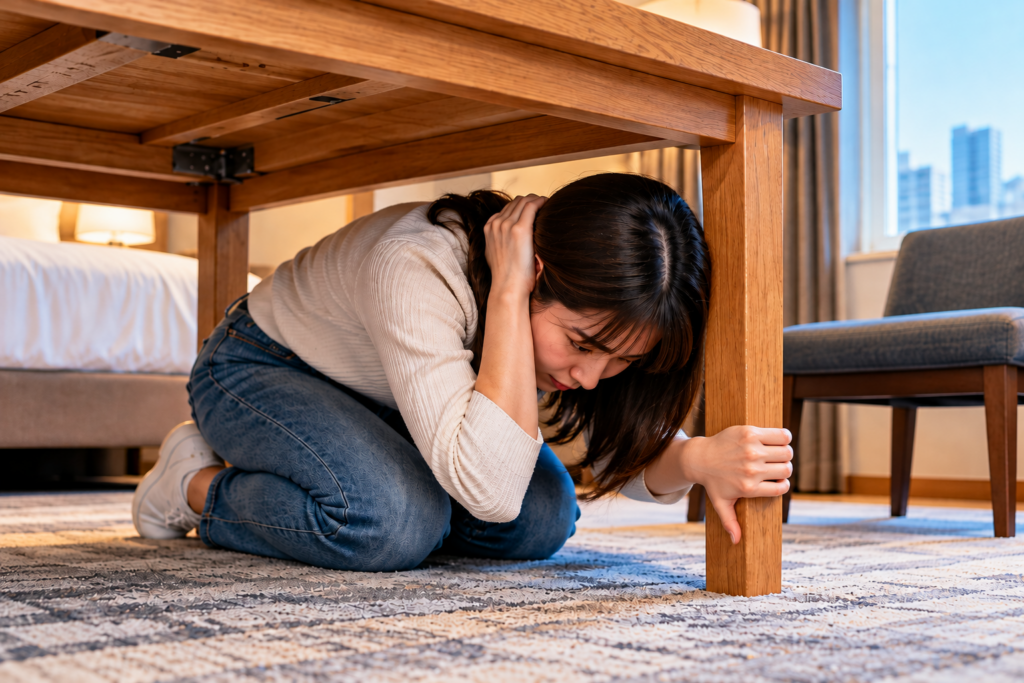
Your first priority during an earthquake is to protect yourself from injury. The safest action depends on where you are when the shaking begins.
If You Are in a Hotel Room
If an earthquake starts while you are in your hotel room, do not immediately run outside.
Move away from windows, mirrors, tall furniture, and objects that could fall. If a sturdy table is nearby, get underneath it, protect your head and neck, and hold on until the shaking stops.
If there is no suitable shelter, crouch in a safer area away from falling objects and protect your head and neck with your arms.
After the shaking stops, check for injuries, damaged exits, smoke, fire, or other hazards. Follow instructions from hotel staff and avoid using elevators until their safety has been confirmed.
If You Are on a Train or Subway
Trains may brake suddenly when an earthquake is detected. If you are standing, hold firmly onto a handrail or strap to avoid falling.
If the train stops, remain calm and listen to announcements from the driver or railway staff.
Never open the doors or step onto railway tracks without instructions from authorized staff. Tracks and surrounding railway equipment can be dangerous.
If you are waiting on a station platform, stay away from the platform edge and protect yourself from falling objects.
If You Are Walking in a City
In busy areas such as Shinjuku, Shibuya, Osaka, or Kyoto, be aware of falling glass, signs, exterior building materials, and unstable walls.
Protect your head and move away from obvious hazards when it is safe to do so. Avoid running blindly through crowds during strong shaking.
After the shaking stops, watch for damaged buildings, broken glass, unstable walls, and blocked streets.
If You Are in an Elevator
If an earthquake occurs while you are in an elevator, press the buttons for all floors and leave at the first floor where it safely stops.
If you become trapped, use the emergency intercom or call button and wait for assistance. Do not attempt to force the doors open or escape through the ceiling.
4. Understanding Japan's Earthquake Early Warning System
Japan operates an Earthquake Early Warning system managed by the Japan Meteorological Agency (JMA).
When an earthquake begins, the system analyzes seismic observations and may issue an alert before strong shaking reaches certain locations.
Warnings may be delivered through television, radio, smartphones, and public announcement systems.
However, earthquake early warnings are not predictions made before an earthquake begins. They are issued after seismic activity has already been detected.
Depending on your location, you may have only a few seconds to react. In areas close to the earthquake's source, strong shaking may arrive before an alert can be issued.
If you receive an alert, stop what you are doing and immediately protect yourself. Do not waste valuable seconds trying to record the warning or check social media.
Not every international smartphone will receive Japan's emergency alerts in the same way. Compatibility can depend on the device, mobile network, and settings.
Listen to Japan's Earthquake Warning Sounds Before Your Trip
Earthquake warning sounds in Japan may be unfamiliar to international visitors. Knowing what they sound like can help you recognize an alert and respond more quickly.
The Japan Meteorological Agency provides official examples of earthquake warning sounds and guidance on what to do when you hear them.
Listen to earthquake warning sounds on the official JMA website (Japanese)
You can also watch a short training video that demonstrates a smartphone earthquake alert and appropriate safety actions.
Watch the official JMA earthquake warning training video (Japanese)
Audio warning: These official examples contain loud emergency alert sounds. Please lower your device volume before playing them, and avoid playing them where they could cause confusion or alarm.
Warning sounds may differ between television broadcasts, mobile phones, and individual applications.
5. Useful Earthquake and Disaster Information Apps
Safety tips
Safety tips is a disaster information app designed to assist international visitors and residents in Japan.
It provides notifications about earthquake early warnings, tsunami warnings, and certain weather-related hazards in multiple languages, including English.
The app also includes disaster guidance and useful communication phrases.
Install it before your trip and check the notification settings and registered locations.
Official Safety tips app information and download links
NHK WORLD-JAPAN
NHK WORLD-JAPAN is a useful source of English-language news and information about major events in Japan, including significant earthquakes and transportation disruptions.
For immediate evacuation decisions, always prioritize current instructions from local authorities, emergency services, and the Japan Meteorological Agency.
6. Tsunami Safety: What Coastal Travelers Must Know
Earthquakes can sometimes generate tsunamis, especially when significant movement occurs beneath the ocean.
A tsunami is not an ordinary ocean wave. It can move a tremendous volume of water inland, damage buildings, and create dangerous currents.
The devastating tsunami following the 2011 Great East Japan Earthquake demonstrated how serious this danger can be.
If you are visiting a beach, harbor, coastal town, or low-lying riverside area, it is especially important to understand tsunami evacuation procedures.
If you experience strong shaking or weak but prolonged shaking near the coast, evacuate immediately to higher ground or an appropriate designated tsunami evacuation facility. Do not wait for an official warning.
Likewise, if a tsunami warning or major tsunami warning is issued, leave dangerous coastal and riverside areas immediately, even if you did not feel an earthquake.
During a tsunami advisory, leave the water and stay away from beaches and other hazardous coastal areas.
Tsunamis can arrive in multiple waves, and later waves may be larger than the first. Do not return to a dangerous coastal area until official warnings or advisories have been lifted and authorities confirm that it is safe.
JMA: Understanding tsunami warnings and advisories
7. What Is a Tsunami Evacuation Tower in Japan?
While traveling along Japan's coastline, you may notice tall structures with exterior staircases and elevated platforms. Some of these are specially designed tsunami evacuation towers.
A tsunami evacuation tower is a structure intended to provide temporary refuge above expected tsunami inundation levels in locations where reaching natural high ground may be difficult.
These facilities can be particularly important in flat coastal areas with limited nearby hills.

Some towers have stairs, ramps, or designated access routes. Their design, capacity, accessibility, and operating conditions vary by location.
Not every tall building is an approved tsunami refuge. Some municipalities designate specific buildings as tsunami evacuation buildings.
Before visiting or staying in a coastal area, check local evacuation maps and identify nearby high ground or officially designated tsunami evacuation facilities.
If a tsunami threatens your location, do not delay evacuation to reach a particular tower when a safer, more accessible route to higher ground is available. Follow local evacuation guidance and use the safest reachable refuge.
8. Understanding Sea Level and Elevation Signs in Japan
Another feature you may notice in Japan is a sign displaying the elevation of a particular location above sea level.
These signs often include the Japanese word 海抜 (kaibatsu), meaning elevation above sea level, followed by a number in meters.

For example, a sign reading "海抜 5.8m" means that the location is approximately 5.8 meters above the reference sea level.
Such signs can help travelers understand the elevation of the area they are visiting.
However, there is one extremely important point to remember:
An elevation sign does not guarantee that a location is safe from a tsunami.
Tsunami risk depends on multiple factors, including coastal geography, the size of the tsunami, local terrain, and the presence of rivers or low-lying areas.
Do not assume that an elevation of five or ten meters automatically makes a location safe.
Instead, consult local tsunami hazard maps and evacuation signs, and follow instructions to reach designated safe areas or higher ground.
9. How to Recognize Tsunami Evacuation Signs
Japan uses various signs and pictograms to identify evacuation locations and routes. Tsunami-related signs may include green-and-white symbols, people moving toward higher ground, or directional arrows.
The appearance of signs can vary, so pay attention to their wording and the type of hazard they address.
| Japanese | English Meaning |
|---|---|
| 津波避難場所 | Tsunami Evacuation Area |
| 津波避難ビル | Tsunami Evacuation Building |
| 津波避難タワー | Tsunami Evacuation Tower |
| 避難場所 | Evacuation Area |
| 高台 | Higher Ground |
| 海抜 | Elevation Above Sea Level |
A general evacuation area is not necessarily designated for tsunami safety. If you are near the coast, look specifically for tsunami evacuation information.
The JMA also provides official illustrated guidance showing tsunami hazard and evacuation symbols.
See official tsunami evacuation symbols in the JMA English safety guide (PDF)
10. What to Do After an Earthquake
Even after the initial shaking stops, hazards may remain. Aftershocks, damaged buildings, fires, landslides, and transportation disruptions can continue to affect an area.
- Check for injuries: Make sure you and your companions are safe. Seek emergency medical assistance if necessary.
- Assess your surroundings: Avoid visibly damaged buildings, unstable walls, broken glass, and other hazards.
- Follow official information: Check announcements from the JMA, local governments, hotel staff, and emergency services.
- Check transportation updates: Trains, buses, flights, and highways may be affected. Do not assume that services are operating normally.
- Contact family or travel companions: Mobile networks may become congested. Internet-based messaging may be useful when available.
- Stay alert for aftershocks: Additional strong shaking can occur after a major earthquake.
Do not rush to resume sightseeing or travel through an affected area before checking local safety conditions.
11. What Should Tourists Prepare Before Visiting Japan?
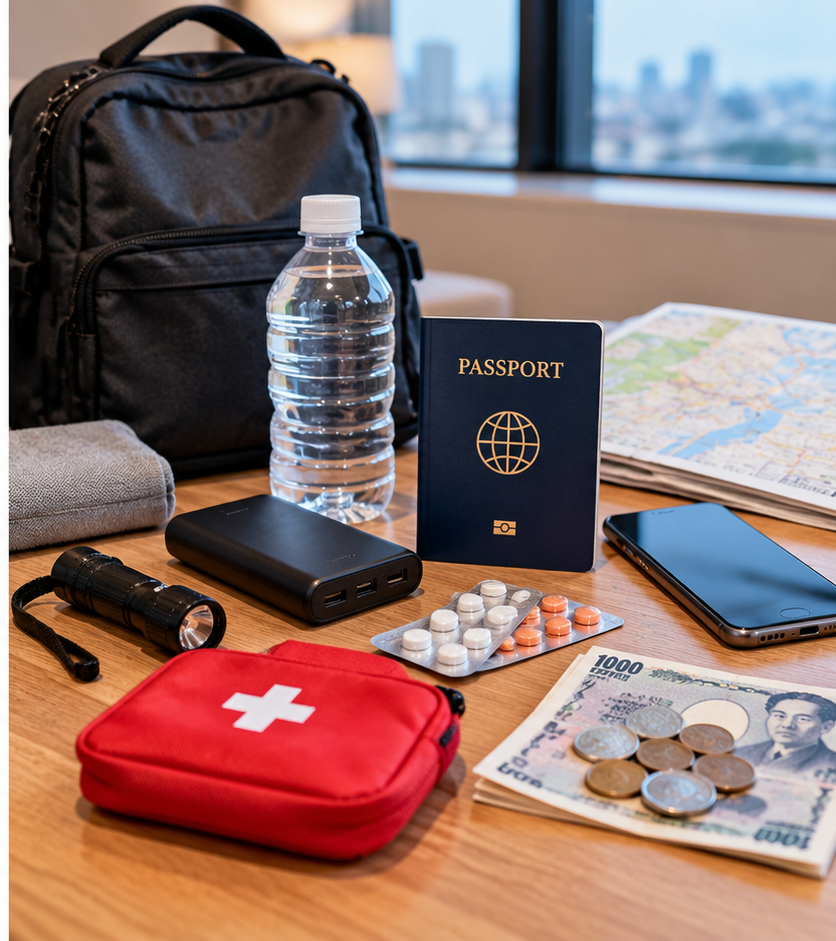
You do not need to carry a large emergency kit throughout your vacation. However, a few simple preparations can be extremely useful.
- A charged smartphone and portable power bank
- Drinking water
- Passport and essential identification
- Necessary prescription medication
- A small amount of cash
- A compact flashlight
- Your hotel's address and contact information
- Offline maps of your destination
- Travel insurance details and emergency contact numbers
When checking into your accommodation, locate emergency exits and learn where guests should gather if evacuation becomes necessary.
If you are staying near the ocean, also identify tsunami evacuation routes and nearby high ground.
Save official emergency information websites to your phone before your trip, so you do not have to search for them during a stressful situation.
12. Emergency Phone Numbers and Useful Japanese Phrases
Although English-language assistance is increasingly available in Japan, some emergency announcements and local instructions may be delivered only in Japanese.
Knowing a few basic words can help you understand signs and communicate with people nearby.
| Japanese | Pronunciation | English |
|---|---|---|
| 地震 | Jishin | Earthquake |
| 津波 | Tsunami | Tsunami |
| 避難 | Hinan | Evacuation |
| 危険 | Kiken | Danger |
| 安全 | Anzen | Safety / Safe |
| 高台 | Takadai | Higher Ground |
| 助けて! | Tasukete! | Help! |
| 避難場所はどこですか? | Hinan basho wa doko desu ka? | Where is the evacuation area? |
| 英語を話せますか? | Eigo o hanasemasu ka? | Do you speak English? |
Emergency Phone Numbers in Japan
- 110: Police emergencies
- 119: Fire and ambulance emergencies
- 050-3816-2787: JNTO Japan Visitor Hotline, available 24 hours a day for visitor assistance, including emergencies and natural disasters
The Japan Visitor Hotline provides assistance in multiple languages, including English. It is a helpful resource for international visitors who need information or assistance during a difficult situation.
Official JNTO Japan Visitor Hotline information
13. Frequently Asked Questions About Earthquakes in Japan
Are earthquakes common in Tokyo?
Yes. Tokyo experiences seismic activity, although not every earthquake causes strong shaking or serious damage. Travelers should understand basic safety procedures and know how to access reliable emergency information.
Should I cancel my trip to Japan because of earthquakes?
The general possibility of earthquakes does not automatically mean that travel to Japan should be avoided. However, if a significant earthquake has recently affected your destination, check official travel advisories, transportation information, and local conditions before deciding whether to travel.
Can tourists receive earthquake alerts in English?
Yes. Multilingual disaster information services such as Safety tips provide earthquake-related alerts and guidance in English. However, delivery depends on device compatibility, settings, and connectivity, so it is wise to prepare more than one information source.
Is it safer to stay inside a hotel during an earthquake?
During strong shaking, it is generally important to protect yourself from falling objects rather than immediately running outside. After the shaking stops, the appropriate action depends on the condition of the building and instructions from hotel staff or emergency authorities.
Is a location 10 meters above sea level safe from a tsunami?
Not necessarily. Elevation alone cannot determine tsunami safety. Local geography, expected inundation areas, and official evacuation plans must also be considered. Follow local tsunami hazard maps and move to designated safe locations.
Can a tsunami reach areas away from the beach?
Yes. Tsunami flooding can affect low-lying inland areas, and tsunami waves may travel upstream along rivers. Do not judge safety only by how far you are from the shoreline.
Can I return to the beach after the first tsunami wave?
No. Tsunamis can arrive in multiple waves, and later waves may be larger. Stay away from hazardous coastal areas until official warnings or advisories have been lifted and authorities indicate that it is safe.
Final Thoughts: Stay Prepared and Enjoy Japan
Japan is a remarkable destination, and earthquakes are one of the natural hazards travelers should understand before visiting.
Fortunately, a little preparation can make a real difference.
Learn how earthquake early warnings work. Check your hotel's emergency exits. Download a trusted disaster information app. If you plan to visit coastal areas, familiarize yourself with tsunami evacuation routes, elevation signs, and designated refuge facilities.
Most importantly, remember that your immediate safety comes first. Protect yourself during shaking, follow reliable official information, and evacuate promptly when tsunami danger is present.
Being informed and prepared is one of the best ways to travel with greater confidence.
At Japan Insider Guide, our goal is to help international visitors understand Japan and enjoy their journeys with practical, reliable information.
Official Sources and Further Reading
- Japan Meteorological Agency — Earthquake Early Warning System
- JMA — Earthquake Warning Sounds and Safety Actions (Japanese)
- JMA — Earthquake and Tsunami Safety Guide (English PDF)
- JNTO — Safety tips Disaster Information App
- JNTO — Japan Visitor Hotline
Important: This article provides general travel safety information and does not replace real-time warnings or instructions from emergency authorities. During an emergency, always follow the latest official guidance for your location.