Driving in Japan: International Driving Permits, Rental Cars & Road Safety
 komatsuna_admin
Japan has many fascinating places that are difficult to reach by train or bus alone.
From Hokkaido's vast landscapes and Okinawa's beautiful coastlines to rural hot-spring towns and small mountain villages, a rental car allows you to travel at your own pace without being tied to public transportation schedules.
However, there are important rules to understand before driving in Japan.
For international visitors, the requirements for an International Driving Permit, left-side traffic, rental-car insurance, and expressway tolls can be confusing.
There is also a serious risk of major accidents if a driver accidentally travels in the wrong direction on an expressway after missing an exit.
This guide explains the requirements for driving legally in Japan, how to prepare for a rental car, basic traffic rules, expressway safety, how to avoid dangerous driving, and what to do in the event of an accident or breakdown.
Review these points before your trip so you can drive in Japan safely and confidently.
1. Can International Visitors Drive in Japan?
International visitors may drive in Japan if they hold a legally recognized driving credential and meet all applicable requirements.
In principle, you need one of the following:
- A valid Japanese driver's license
- A valid International Driving Permit issued under the 1949 Geneva Convention
- A driver's license issued by one of the countries or regions recognized by Japan, together with an approved Japanese translation
Simply holding a foreign driver's license does not necessarily allow you to drive in Japan.
There may also be restrictions on the types of vehicles you can drive and the period during which you may drive.
The first step is to confirm before departure that your license or permit is valid in Japan.
2. Important Information About International Driving Permits
Japan Recognizes the 1949 Geneva Convention Format
An International Driving Permit is commonly abbreviated as an IDP.
However, not every international driving permit issued around the world is valid in Japan.
In principle, Japan recognizes International Driving Permits issued in the prescribed format under the 1949 Geneva Convention on Road Traffic.
International Driving Permits issued under the 1968 Vienna Convention are not valid for driving in Japan.
Therefore, obtaining an international driving permit in your home country does not automatically mean that you can drive legally in Japan.
Check the issuing country or region, the applicable convention, and the format of the document.
For further information, see the Japan Automobile Federation (JAF) guidance on driving licenses in Japan.
The Valid Driving Period Is Also Limited
The period during which you may drive in Japan with an International Driving Permit is generally the shorter of:
- One year from the date you entered Japan
- The validity period of the International Driving Permit itself
Additional restrictions may apply to residents of Japan who leave the country temporarily and then re-enter.
You may also drive only the vehicle categories authorized by your International Driving Permit.
Documents to Prepare Before Departure
The exact document-checking process varies by rental-car company, but you will generally need:
- A valid International Driving Permit or another document proving that you are authorized to drive in Japan
- The original driver's license used as the basis for your International Driving Permit
- Your passport
- Any identification documents and payment method required by the rental-car company
Unofficial "international licenses" or translation cards sold online are not necessarily legally valid in Japan.
Always check the requirements with the official issuing authority and Japanese government sources.
3. Driving Without an International Driving Permit
A separate system applies to driver's licenses issued by certain countries and regions.
The eligible countries and region are:
- Germany
- France
- Switzerland
- Belgium
- Monaco
- Taiwan
Visitors holding licenses issued by these countries and region may be allowed to drive in Japan with a valid driver's license and a Japanese translation prepared by an authorized issuing organization.
Depending on the license, the translation may need to be prepared by the issuing authority, an authorized embassy or consulate, JAF, or another organization recognized under Japanese law.
A translation prepared personally or generated only with a general translation app cannot be used as a substitute.
This system also has limits on how long you may drive in Japan.
Check the latest official information before traveling, including the eligible countries and region and the approved translation procedure. The JAF English website is a useful starting point.
4. What to Check Before Renting a Car in Japan
Once you have confirmed that you are legally allowed to drive, the next step is booking a rental car.
Rental cars are available at airports, major train stations, and tourist destinations throughout Japan.
Some companies offer English-language booking services, but the level of foreign-language support varies by branch.
What to Check When Booking
1. Driver's license requirements
Before booking, confirm that the license, permit, and translation documents you plan to bring will be accepted by the rental-car company.
2. Vehicle size
Japan has many narrow roads and small parking spaces. If you are not used to driving in Japan, choosing a smaller vehicle may make your trip easier and safer.
3. Navigation and smartphone connectivity
Check whether the vehicle has an English-language navigation system and whether you can connect your smartphone or use a map app.
4. ETC card
If you plan to use expressways, check whether the rental company offers an ETC card.
5. Insurance and coverage
Do not check only whether insurance is included in the rental price. Confirm the deductible and your potential out-of-pocket costs in the event of an accident.
6. Return location and opening hours
One-way rentals may be available, but an additional fee may apply.
Also confirm whether you must return the vehicle with a full tank of fuel.
What Are CDW and NOC?
Rental-car pricing often includes unfamiliar abbreviations.
CDW, or Collision Damage Waiver, is a program that may reduce or waive your liability for certain vehicle damage. The coverage and conditions vary by company and plan.
NOC, or Non-Operation Charge, is a fee that may be charged when a vehicle cannot be used for business because of an accident or damage. It is similar to compensation for the rental company's loss of use.
Even if you purchase CDW, NOC may still be charged separately.
Do not assume that every cost is covered simply because the rental plan is described as "insured."
5. Basic Traffic Rules in Japan
Drive on the Left
Vehicles drive on the left side of the road in Japan.
Most passenger cars are right-hand drive.
Visitors from countries where traffic keeps to the right should be especially careful after turning at intersections and when entering a public road from a parking area.
Until you become comfortable, ask your passenger to help confirm which lane you should be using.
Give Priority to Pedestrians
At pedestrian crossings, drivers must not obstruct pedestrians who are crossing or preparing to cross.
Even at an uncontrolled pedestrian crossing, you must stop before the crossing when a pedestrian is waiting to cross.
Obey Stop Signs
Japanese stop signs are red, inverted triangles.
At a stop sign, come to a complete stop at the designated stopping point before proceeding.
Take Extra Care at Railway Crossings
As a general rule, drivers must stop immediately before a railway crossing and check that it is safe before proceeding. Some crossings are controlled by traffic signals, so always follow the signal indication where applicable.
Never enter a crossing after the warning bells have started ringing.
If traffic is backed up on the other side, do not enter the crossing. You could become trapped on the tracks.
Obey Speed Limits
Speed limits vary by road.
Even on expressways, the same speed limit does not apply to every section.
Check the signs and road conditions, and always obey the posted speed limit.
6. Japanese Expressways and ETC
Most expressways in Japan require toll payments.
The toll depends on the road, distance, vehicle type, and other factors.
What Is ETC?
ETC stands for Electronic Toll Collection. It is a system that allows drivers to pay expressway tolls electronically.
You need both an ETC in-vehicle unit and a valid ETC card.
Even if your rental car has an ETC unit, an ETC card may not be included automatically.
Check the rental company's card-rental conditions when booking.
When entering an ETC-only lane, slow down sufficiently, follow the signs, and maintain a safe distance from the vehicle ahead.
Expressway Entrances and Exits
Japanese expressways may have multiple junctions, branches, and interchanges.
While driving, do not rely only on the navigation system. Also check road signs and arrows painted on the road.
If you are about to miss a branch, do not make a sudden lane change or emergency stop.
Service Areas and Parking Areas
Expressways have service areas and parking areas where you can take a break.
Facilities such as restrooms, restaurants, shops, and fuel stations vary by location.
On long drives, take regular breaks and avoid driving when tired.
7. How to Prevent Wrong-Way Driving on Expressways
This is an especially important section for anyone renting a car in Japan.
Driving in the wrong direction on an expressway can lead to a head-on collision with vehicles traveling correctly.
Japanese expressways are generally designed for one-way traffic in each direction.
Even if you miss your destination or exit, you must never turn around on your own.
Where Does Wrong-Way Driving Commonly Occur?
Wrong-way driving can occur near:
- Interchanges and toll plazas
- Expressway exits
- Entrances and exits of service areas and parking areas
- Complex junctions and merging points
When returning to the main expressway from a rest facility, be especially careful not to confuse the entrance and exit.
What Should You Do If You Miss Your Exit?
Never reverse or make a U-turn.
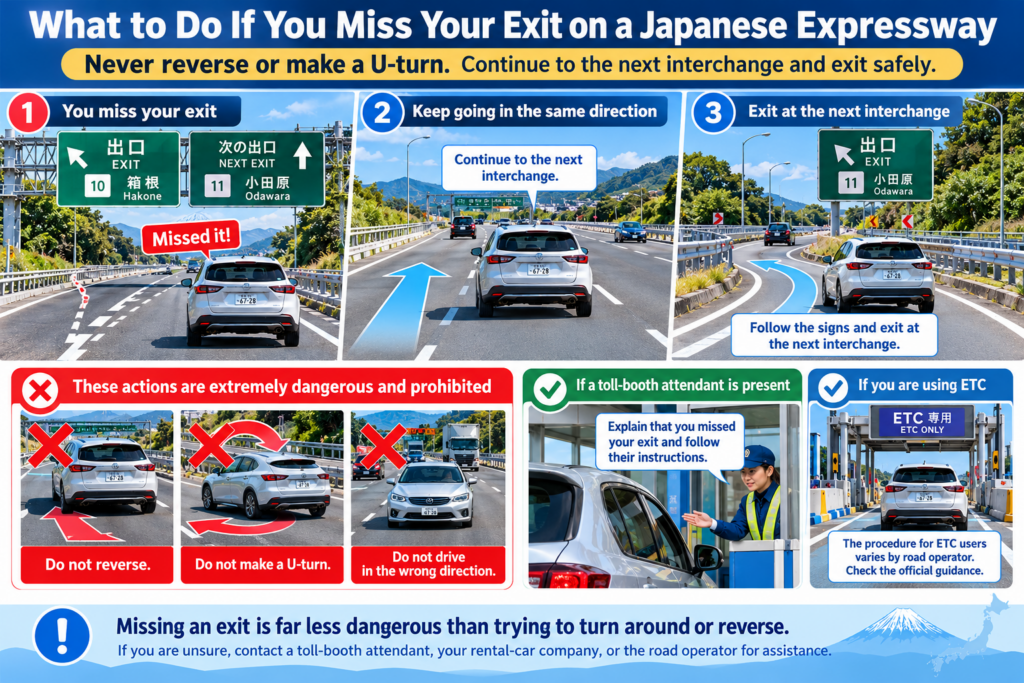
If you miss your exit, continue driving in the correct direction and leave the expressway at the next interchange.
If a toll-booth attendant is present, explain the situation before completing payment and follow the instructions provided.
The exact procedure for ETC users depends on the road operator and toll-booth facilities, so check the relevant official guidance.
Depending on the interchange structure, staff may not be able to direct you back to the exact location you intended to reach.
Missing an exit is far less dangerous than trying to turn around or reverse.
See NEXCO Central Japan's guidance on missing an expressway exit for further information.
What Should You Do If You Encounter a Wrong-Way Vehicle?
If road information signs warn of a wrong-way vehicle, reduce your speed, increase your following distance, and watch the road ahead carefully.
If you see a vehicle traveling in the wrong direction, prioritize avoiding a collision and stop in a safe location if possible.
The emergency number for the police in Japan is 110.
The driver must not use a smartphone while driving to make a report. Ask a passenger to call, or contact the authorities after reaching a safe location.
What If You Realize That You Are Driving the Wrong Way?
If you realize that you are traveling in the wrong direction, do not attempt to make a U-turn.
Stop in a location where it is safe to do so, turn on your hazard lights, and move to a safe place away from traffic if you can do so safely. Then contact the police at 110 or use an emergency telephone on the expressway.
The safest way to stop and evacuate depends on the traffic situation. Watch carefully for approaching vehicles and follow instructions from the police or road operator.
For more information, visit NEXCO Central Japan's wrong-way driving prevention page.
8. Important Safety Points While Driving
Never Drive Under the Influence of Alcohol
Driving under the influence of alcohol is strictly prohibited in Japan.
Even a small amount of alcohol can affect your ability to drive.
If you plan to drink, make arrangements that do not involve driving.
Avoid Speeding and Dangerous Driving
Always obey the speed limit and adjust your speed to the road and traffic conditions.
Speeding can lead to serious accidents.
Never engage in sudden acceleration or braking, abrupt lane changes, tailgating, dangerous overtaking, or other aggressive driving.
Dangerous driving is not limited to driving at excessive speed. It may also include repeated risky driving in groups on public roads or in parking areas, ignoring traffic signals, weaving between lanes, unnecessary horn use, cutting in suddenly, or intimidating other drivers and pedestrians.
Driving noisily through residential areas, busy tourist areas, or places with many pedestrians at night can disturb residents and other visitors and may lead to accidents or conflicts. Do not modify a vehicle to produce excessive noise.
In Japan, dangerous driving, extreme speeding, obstructive driving, and other conduct may be subject to penalties. The specific violation and penalty depend on the conduct and road conditions, but renting a car does not exempt you from responsibility.
If you see dangerous driving, do not chase the vehicle, approach it to take photographs, or provoke the driver. Move to a safe location and call 110 if there is an immediate danger. Never use your smartphone while driving.
Visitors who are unfamiliar with Japanese roads should not feel pressured to match the speed or behavior of surrounding vehicles. Keep a safe following distance and drive calmly.
Do Not Use Your Smartphone While Driving
Holding a smartphone to make a call or looking closely at its screen while driving is prohibited.
Set your destination and change your route only after stopping in a safe location.
Snow and Icy Roads
Hokkaido, Tohoku, and mountainous areas may experience snow and icy roads during winter.
Confirm that the vehicle has appropriate equipment, such as winter tires. If you have no experience driving in winter conditions, consider avoiding the drive altogether.
Some roads and regions have requirements concerning winter tires or tire chains.
Mountain Roads and Narrow Streets
Rural tourist destinations may have narrow roads and curves with limited visibility.
Slow down and watch carefully for oncoming vehicles, pedestrians, and cyclists.
Be Careful About Illegal Parking
Parking on public roads is prohibited or restricted in many areas of Japan.
At tourist destinations, use designated parking facilities.
If you receive a parking violation while driving a rental car, you may be responsible not only for the fine but also for fees charged by the rental company.
9. What to Do in an Accident or Breakdown
Even careful drivers can experience problems on unfamiliar roads.
Prepare the necessary contact information before you begin driving.
Emergency Numbers
- 110: Police
- 119: Ambulance and fire services
If anyone is injured, prioritize first aid and safety. Call 119 when necessary.
Traffic accidents must be reported to the police.
Even after a minor collision, do not settle the matter privately with the other driver. Contact the police and the rental-car company.
Contact the Rental-Car Company
If you are involved in an accident or experience a breakdown, contact the rental company's emergency number.
If you fail to report the incident promptly or do not follow the required procedures, your insurance or coverage may not apply.
If Your Vehicle Stops on an Expressway
A stopped vehicle on an expressway can be struck by following traffic, creating a serious secondary accident.
If possible, use your hazard lights and other warning devices to alert approaching vehicles. Do not walk into the traffic lanes. Leave the vehicle and move behind a guardrail or to another safe location if it is safe to do so.
Remaining inside the vehicle can also be dangerous.
After reaching a safe location, use an emergency telephone or Japan's road emergency number, #9910, to contact the road operator.
See NEXCO Central Japan's expressway information for international visitors for additional guidance.
10. Regions Where a Rental Car Can Be Useful
The need for a car varies greatly between urban and rural areas of Japan.
Hokkaido
A rental car can be convenient for visiting vast natural areas and scenic destinations.
However, distances between destinations can be long, and snow and icy roads create additional risks in winter.
Plan a flexible itinerary with plenty of time.
Okinawa
A rental car can be useful for visiting coastal attractions and places that are difficult to reach by public transportation.
Traffic congestion can occur during busy travel seasons.
Rural Hot-Spring Towns and Mountain Areas
A rental car may be a practical option when visiting accommodations or scenic spots far from train stations.
Take extra care on mountain roads, narrow streets, and roads affected by winter snow.
Tokyo, Osaka, Kyoto, and Other Major Cities
In large cities, trains and buses are often more convenient than driving.
Consider parking availability and cost, traffic congestion, and whether you really need a rental car.
If you plan to travel by rail, our beginner's guide to using trains in Japan can help you get started.
For many trips in Japan, the best approach is to combine public transportation with a rental car according to your destination.
11. Pre-Drive Safety Checklist
Before collecting your rental car, confirm the following:
- I have a driver's license, International Driving Permit, or other document valid in Japan.
- I have confirmed whether I need an approved Japanese translation and have prepared my passport.
- I have confirmed the document requirements with the rental-car company.
- I understand the insurance, deductible, and NOC conditions.
- I have checked the vehicle for existing damage.
- I have set up the navigation system and destination.
- I have confirmed whether an ETC card is available and how tolls will be paid.
- I understand that traffic keeps to the left in Japan.
- I understand that I must never reverse or make a U-turn on an expressway.
- I understand that dangerous driving, tailgating, and risky overtaking are prohibited.
- I have saved the emergency contact numbers.
- I have checked the weather and road conditions.
- I have planned a realistic itinerary with enough time.
12. Conclusion: Discover More of Japan Safely
A rental car can greatly expand the way you experience Japan.
You may discover beautiful scenery far from train stations, small-town restaurants, and local hot springs that are difficult to reach by public transportation.
At the same time, international visitors must understand the requirements for their driving credentials and follow Japanese traffic rules.
The four most important points are:
First, confirm before departure that you are legally authorized to drive in Japan.
Second, follow Japanese traffic rules, including left-side driving.
Third, never reverse or make a U-turn on an expressway, even if you miss your exit.
Fourth, never engage in speeding, tailgating, dangerous overtaking, group driving, or other dangerous behavior.
Put safety first, allow plenty of time, and enjoy your journey.
Beyond the windshield, you may find a side of Japan that cannot be discovered from a guidebook alone.
Official Information and Useful Resources
- National Police Agency — Traffic Information
- Japan Automobile Federation (JAF) — Driving in Japan with a Foreign License
- NEXCO Central Japan — Missing an Expressway Exit
- NEXCO Central Japan — Preventing Wrong-Way Driving
- NEXCO Central Japan — Expressway Information
Driving regulations, rental conditions, and road restrictions may change. Always confirm the latest requirements with the relevant authorities and your rental-car company before traveling.