Japanese Izakaya Guide: How to Order, Pay & Enjoy Like a Local
 komatsuna_admin
Step through the noren curtains of a Japanese izakaya, and you may discover a side of Japan that is rarely found in guidebooks. Warm lanterns, lively conversations, and tables filled with small dishes create a welcoming atmosphere that is distinctly Japanese.
But if you have never visited an izakaya before, you might have questions. Do you need a reservation? Why did a small dish arrive before you ordered anything? What does “all-you-can-drink” really mean? And how do you pay?
This guide explains how Japanese izakaya restaurants work, what to order, which extra charges to watch for, and how to enjoy the experience with confidence. Whether you choose a familiar restaurant chain or a small neighborhood establishment, an izakaya can offer a memorable glimpse into everyday Japanese life.
1. What Is an Izakaya? Discover Japan's Casual Dining Culture
An izakaya is a casual Japanese establishment where people enjoy drinks alongside a wide variety of food. It is sometimes described as a Japanese pub, but the experience is not quite the same as visiting a pub in Europe or North America.
At an izakaya, food plays a central role. You can order grilled chicken skewers, sashimi, fried chicken, vegetables, grilled fish, salads, and many other dishes. Instead of ordering one main course per person, groups often choose several smaller dishes to share.
For many Japanese people, izakaya restaurants are places to unwind after work, catch up with friends, or celebrate special occasions. They are social spaces as much as dining establishments.
You do not necessarily have to drink alcohol. Many izakaya restaurants offer soft drinks and non-alcoholic options, although some establishments require each guest to order at least one beverage.
2. Chain Izakaya vs. Local Izakaya: Which Should You Choose?
Japanese izakaya restaurants range from large nationwide chains to tiny, independently operated neighborhood establishments. Both can be enjoyable, but they offer different experiences.
Chain Izakaya: A Convenient First Experience
For first-time visitors, a chain izakaya can be a comfortable introduction to Japanese dining culture.
- Menus often include photographs.
- Some locations use tablets or QR codes for ordering.
- Prices are usually displayed clearly.
- Many locations can accommodate groups.
- Some restaurants offer menus in English or other languages.
However, services vary between locations, even within the same chain. Do not assume that every restaurant has an English menu or accepts the same payment methods.
Independent Izakaya: A Taste of Local Japan
Small, independently operated izakaya restaurants can offer a more personal experience. The owner may prepare regional specialties, recommend locally produced sake, or chat with regular customers across the counter.
These places can feel less familiar to international visitors. Menus may be handwritten in Japanese, seating may be limited, and some restaurants accept cash only.
A good approach is to try a chain izakaya first, then explore a smaller local establishment once you understand the basics.
3. Entering an Izakaya: Reservations and Seating
Do You Need a Reservation?
Many izakaya restaurants welcome walk-in customers, but popular locations can become crowded on Friday and Saturday evenings, before public holidays, and during busy travel periods.
Reservations are recommended for larger groups or restaurants you particularly want to visit. Depending on the establishment, you may be able to book by telephone, through its official website, or via a restaurant reservation service.
What Happens When You Enter?
Staff may greet you by asking, “Nanmei-sama desu ka?” meaning “How many people?” Tell them your party size and wait to be seated.
Common seating arrangements include:
- Counter seats: Convenient for solo diners or couples, sometimes with a view of the kitchen.
- Table seats: Suitable for friends, families, and groups.
- Tatami or floor seating: Traditional-style seating where guests may need to remove their shoes.
- Private rooms: Useful for group conversations, although additional charges may apply.
If you are unsure whether to remove your shoes, follow the staff's instructions or look for signs near the seating area.
4. How to Order Food and Drinks at an Izakaya
At many izakaya restaurants, customers order drinks first and then choose food. You can usually add more dishes throughout the meal rather than ordering everything at once.
Ordering Directly from Staff
Traditional izakaya restaurants often take orders at the table. If you do not speak Japanese, pointing to a menu photograph or using a translation app may help.
Ordering with a Tablet
Some chain restaurants provide tablets with digital menus. Certain systems offer English or other language options, making it easier to view dishes and prices.
Ordering with a QR Code
Some restaurants ask customers to scan a QR code with their smartphones and place orders through a website. Mobile internet access or restaurant Wi-Fi may be needed.
Can You Order More Food Later?
Yes. Ordering a few dishes first and adding more as you eat is a normal part of the izakaya experience. However, popular seasonal dishes may sell out, so order early if there is something you particularly want to try.
5. What Is Otoshi? Understanding Japan's Small Appetizer Charge
One of the most surprising aspects of visiting an izakaya for the first time is otoshi.
Otoshi is a small appetizer served shortly after you sit down, often before your ordered food arrives. It might be edamame, simmered vegetables, a small salad, or another seasonal dish.
Even though you did not order it, the dish may appear as a charge on your bill. This is a traditional practice at many Japanese izakaya restaurants.
How Much Does Otoshi Cost?
The price varies by restaurant. It is often a few hundred yen per person, but it can be higher. Some restaurants do not serve otoshi, while others charge a separate seating or cover fee instead.
Can You Refuse Otoshi?
That depends on the restaurant. Some establishments may allow you to decline the appetizer, while others treat it as part of a mandatory cover charge.
If you are concerned about extra costs, ask before ordering or check the restaurant's posted pricing information.
Remember: Otoshi is not necessarily a complimentary appetizer. Knowing this beforehand can help prevent confusion when the bill arrives.
6. Popular Izakaya Food and Drinks to Try
One of the best things about an izakaya is the opportunity to sample many different flavors during a single meal.
Popular Izakaya Dishes
Yakitori — Grilled Chicken Skewers
Pieces of chicken are grilled on skewers, usually seasoned with salt or a sweet and savory sauce called tare.
Karaage — Japanese Fried Chicken
Juicy pieces of seasoned chicken are fried until crisp. Karaage is a favorite at many izakaya restaurants.
Edamame — Boiled Green Soybeans
These lightly salted soybeans are a classic snack, often enjoyed with beer.
Sashimi — Sliced Raw Seafood
Fresh fish or other seafood is served in slices, often with soy sauce and wasabi. If you prefer cooked food, there are plenty of alternatives.
Dashimaki Tamago — Japanese Rolled Omelet
A soft, layered omelet flavored with Japanese soup stock.
Grilled or Simmered Fish
Depending on the region and season, izakaya menus may feature a variety of local fish dishes.
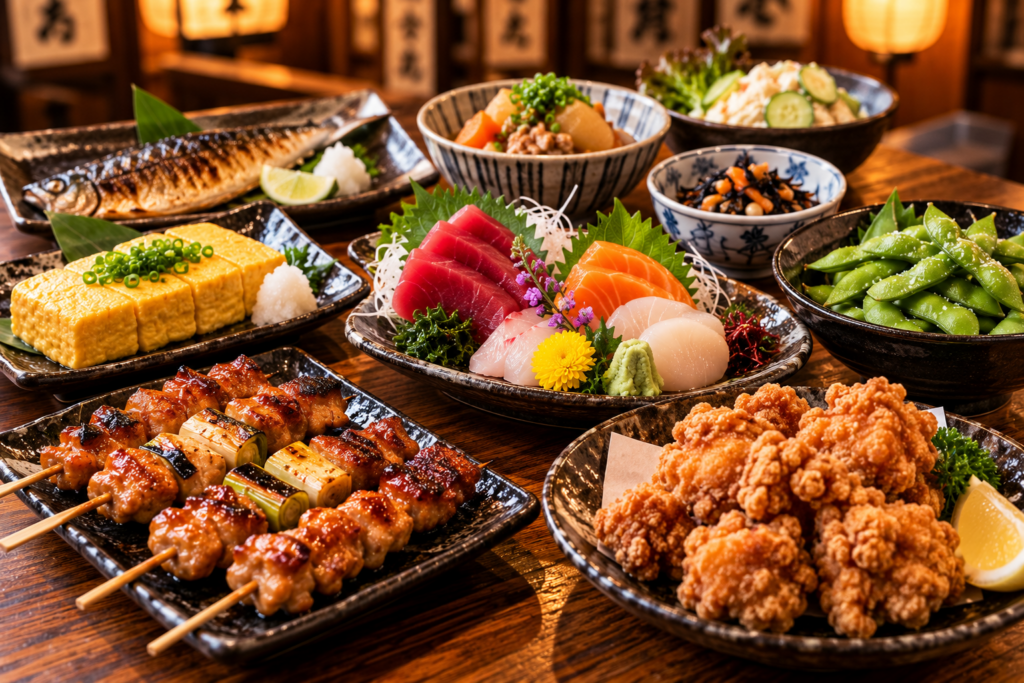
Popular dishes commonly found at Japanese izakaya restaurants.
Popular Izakaya Drinks
Beer: Draft beer is a popular choice, particularly for the first toast.
Sake: Japanese rice-based alcoholic beverages are available in many styles and may be served chilled, at room temperature, or warm.
Shochu: A Japanese distilled spirit that may be served with water, ice, hot water, or mixers.
Highball: Typically whisky mixed with soda water and served over ice.
Sour: A mixed drink often made with shochu or another spirit and flavored with citrus or other ingredients.
Non-alcoholic drinks: Many restaurants offer tea, juice, soft drinks, and sometimes non-alcoholic beer.
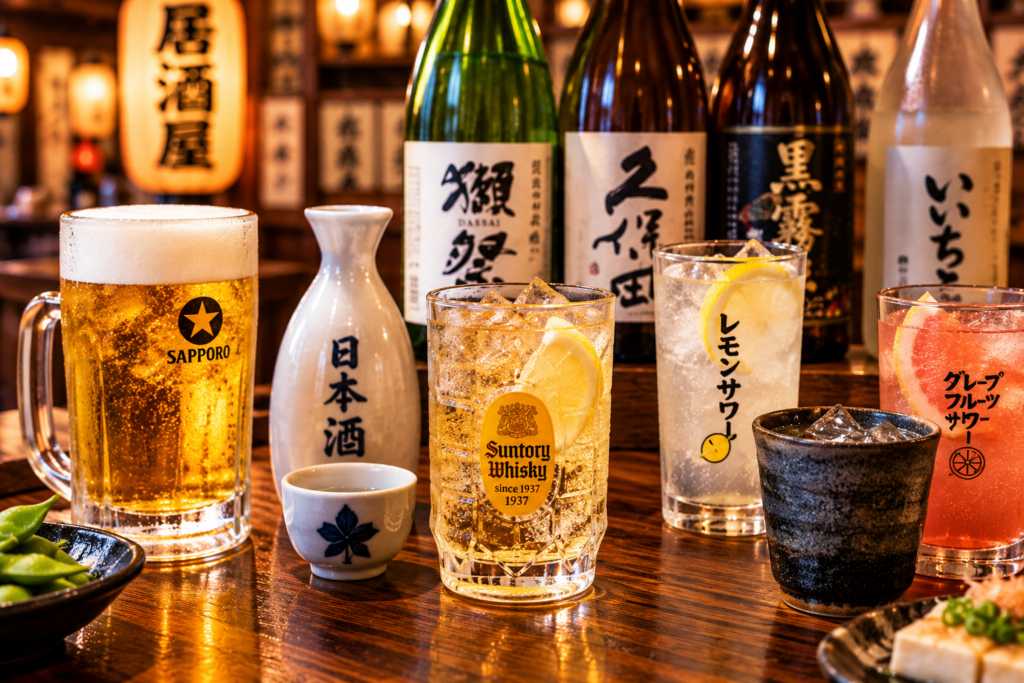
Common drinks served at Japanese izakaya restaurants.
Important: The legal drinking age in Japan is 20. Never drive after drinking alcohol.
7. How Does Nomihodai (All-You-Can-Drink) Work?
Some izakaya restaurants offer nomihodai, an all-you-can-drink plan that allows customers to order drinks from a designated menu during a fixed period.
Plans commonly last 90 or 120 minutes, although duration, pricing, and conditions vary between establishments.
What Should You Check Before Ordering?
- How long does the plan last?
- When is the last order?
- Which drinks are included?
- Must everyone in the group choose the same plan?
- Is a food order or set-course meal required?
- Are there extension fees or cancellation conditions?
Not every alcoholic beverage on the regular menu is necessarily included. Some restaurants also charge for excessive leftover drinks.
All-you-can-drink does not mean you should drink as much as possible. Enjoy yourself responsibly and at your own pace.
8. Paying at an Izakaya: Bills, Extra Charges, and Splitting Costs
Before visiting an izakaya, it helps to understand that your final bill may include more than the prices of the dishes and drinks you ordered.
Possible Extra Charges
- Otoshi appetizer charges
- Seating or cover charges
- Service fees
- Private-room charges
- Additional all-you-can-drink fees
- Consumption tax, depending on whether displayed prices include tax
These charges do not apply at every restaurant. Check menus, signs, and reservation details to understand the pricing before ordering.
Where Do You Pay?
At some izakaya restaurants, staff bring a bill to your table and you pay at the register. At others, payment takes place at your seat.
Simply say “Okaikei onegaishimasu” (“The bill, please”), and staff will guide you.
Can You Split the Bill?
Splitting costs among friends, known as warikan, is common in Japan. However, some restaurants cannot process separate payments for individual guests.
If you need separate bills, ask the staff before paying, preferably before ordering.
Cash, Credit Cards, and Digital Payments
Many izakaya restaurants accept credit cards or digital payment methods, but some smaller establishments are cash-only.
For more information, read our How to Pay in Japan guide, which explains common payment methods for international travelers.
9. Essential Izakaya Etiquette
Say Kanpai Before Drinking
When dining with a group, it is common to wait until everyone's drinks have arrived before saying “Kanpai!” — the Japanese equivalent of “Cheers!”
It is a friendly custom rather than an absolute rule.
Share Dishes Considerately
Many izakaya dishes are intended for sharing. Use serving utensils when provided, and check with your companions before dividing dishes that may be intended for one person.
Be Mindful of Noise
Izakaya restaurants can be lively, but excessive shouting or behavior that disturbs other guests is best avoided.
Check the Smoking Policy
Japan restricts indoor smoking in restaurants, but certain establishments, including some qualifying smaller businesses, may operate under exceptions.
If you prefer a smoke-free environment, check the restaurant's policy before entering.
Do You Need to Tip?
Tipping is generally not customary at Japanese restaurants. However, an izakaya may have separate seating or service charges, so review the bill if anything is unclear.
10. Useful Japanese Phrases for Visiting an Izakaya
Some neighborhood izakaya restaurants have Japanese-only menus. A few simple phrases can make your visit easier and more enjoyable.
| Japanese | Pronunciation | English Meaning |
|---|---|---|
| 何名様ですか? | Nanmei-sama desu ka? | How many people? |
| 二人です | Futari desu | There are two of us. |
| メニューをください | Menyū o kudasai | May I have a menu? |
| これをください | Kore o kudasai | I'd like this, please. |
| おすすめは何ですか? | Osusume wa nan desu ka? | What do you recommend? |
| これは何ですか? | Kore wa nan desu ka? | What is this? |
| お通しはいくらですか? | Otōshi wa ikura desu ka? | How much is the otoshi? |
| お会計お願いします | Okaikei onegaishimasu | The bill, please. |
| カードは使えますか? | Kādo wa tsukaemasu ka? | Do you accept cards? |
Translation apps can also help, especially when reading handwritten menus. However, machine translations are not always accurate.
If you have food allergies, contact the restaurant in advance whenever possible. Do not rely on a translation app alone to confirm that a dish is safe for you.
11. Practical Tips for Your First Izakaya Visit
Choose an approachable restaurant.
A place with menu photographs and clear prices can make your first experience easier.
Start with a small group.
Solo travelers and couples may find it easier to get seats at busy establishments.
Set a comfortable budget.
Allow for possible otoshi, seating, and service charges in addition to food and drinks.
Check your transportation home.
Last-train times vary by city and railway line. A restaurant may remain open long after public transportation stops running.
Explore a local establishment when you feel ready.
Trying regional dishes or chatting with a friendly owner can turn a simple meal into a memorable cultural experience.
12. Final Thoughts: Discover Everyday Japan Through Izakaya Culture
A Japanese izakaya is more than a place to eat and drink. It is a window into everyday life, where colleagues relax after work, friends gather around shared dishes, and regional food traditions come alive.
At first, customs such as otoshi, seating charges, all-you-can-drink plans, and shared dishes may seem unfamiliar. But understanding a few basics can make the experience much more comfortable.
Whether you choose a convenient chain restaurant or a small neighborhood izakaya, approach the experience with curiosity, respect, and an appetite for something new.
On your next trip to Japan, look for the glow of a red lantern and the traditional noren curtains hanging over a doorway.
Beyond that entrance, you might discover a side of Japan that no ordinary sightseeing itinerary can offer.